

 Facebook
 X
X
 Pinterest
 Copy Link
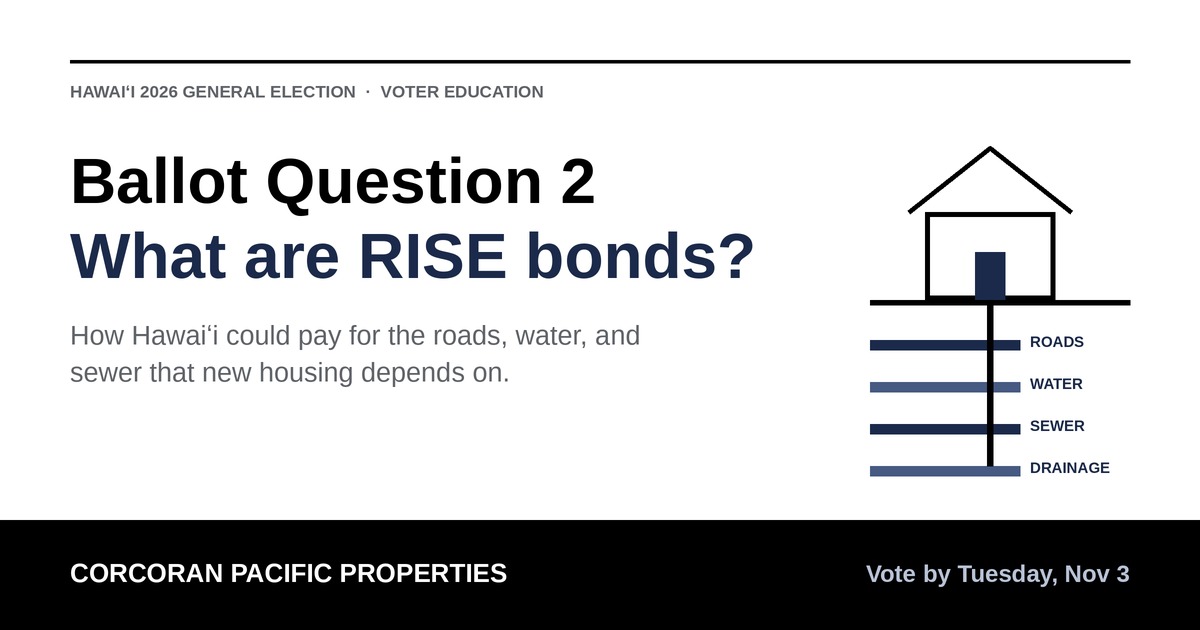
Hawaiʻi Ballot Question 2: What Are RISE Bonds and Why Do They Matter?
A constitutional amendment on the November 3 ballot would give Hawaiʻi’s counties a new way to pay for the infrastructure that housing depends on. Here’s what it would do, how the financing works, what supporters and critics say, and why the voting rules mean you shouldn’t leave it blank.
When your ballot arrives this fall, there’s a question near the end that deserves more than a quick glance: Question 2, concerning Resilient Infrastructure for Shelter and Equity, or RISE bonds.
The wording is technical, but the underlying issue is one every island faces: how do we pay for the roads, water, sewer, and drainage needed before new homes can be built? Whether you own a home, rent, or hope to buy someday, and however you end up voting, it’s worth knowing what this question actually does.
The question asks whether Hawaiʻi’s Constitution should be amended so the Legislature can authorize counties to issue RISE bonds to fund public improvements for housing and community development within designated districts.
Those bonds would be repaid from future growth in property-tax revenue within those districts, not by raising property-tax rates. RISE debt would be excluded from normal county debt limits and subject to accountability and oversight requirements set by law.
Read the official ballot language at the Hawaiʻi Office of Elections
Why infrastructure matters to housing
We often talk about Hawaiʻi’s housing shortage as though the answer is simply to build more homes. Before homes can go up, though, the ground under them needs water lines, sewer and wastewater capacity, drainage, roads, and utilities.
The Legislature’s committee report on the proposal named water, wastewater, drainage, roads, and sea-level-rise mitigation among the infrastructure needs tied to housing, and concluded that existing funding tools weren’t keeping up with the scale and timing of those needs.
Today, much of that cost is often carried up front by the developer and folded into the price of the homes. On Oʻahu, discussion of RISE has focused heavily on housing along the Skyline rail line; on Kauaʻi, Maui, and Hawaiʻi Island, infrastructure capacity often decides where new housing is possible at all.
How RISE financing would work
The concept is called value-capture financing, often known as tax-increment financing. Here’s the sequence:
A county designates a district where infrastructure is needed to enable housing or community development.
RISE bonds are issued to finance the public infrastructure in that district: roads, water, sewer, drainage.
The infrastructure makes development possible. As homes and properties are built, the district’s tax base grows.
A portion of that future increase in property-tax revenue, not an increase in tax rates, repays the bonds.
Build the infrastructure now, development follows, the tax base grows, and a portion of that future revenue growth pays for the infrastructure. Existing property owners’ tax rates are not increased.
Materials submitted to the Legislature and the General Contractors Association of Hawaiʻi describe this type of financing as authorized in 48 states. Each state sets its own rules and safeguards, so programs differ, but the underlying concept is well established elsewhere.
Why it’s on the ballot
Hawaiʻi’s Constitution limits how much debt counties can carry. The amendment would expressly authorize RISE bonds and exclude qualifying RISE debt from counties’ funded-debt calculations. Because it changes the Constitution, voters have the final say.
What supporters and critics say
Supporters
Counties, planners, developers, and the construction industry argue that RISE would let infrastructure be built ahead of housing without dipping into existing tax revenue or raising rates, lowering the up-front cost that gets passed on to buyers.
Lawmakers were told during hearings that taxpayers would not be on the hook if a development falls short.
Critics
The Tax Foundation of Hawaiʻi, the main opposing voice in testimony, argues the amendment isn’t needed because tax-increment financing is already allowed by state statute.
Others may reasonably want to see how districts will be chosen and what protections will be written into law before counties commit future revenue.
Giving counties another financing tool doesn’t mean every future RISE project would be a good one. Fair questions include how districts are selected, what projects qualify, how much future tax growth can be committed, and what happens if development doesn’t arrive as projected. The amendment leaves those details to future legislation, with accountability and oversight requirements set by law.
Don’t leave Question 2 blank
Hawaiʻi’s rules for approving constitutional amendments are unusual. According to the Hawaiʻi Office of Elections, an amendment must win a majority of the votes counted after blank and overvotes are set aside, and the yes votes must also equal at least 50% of all ballots cast, including blank and overvotes.
In practice, a blank on Question 2 works against passage. It isn’t a neutral choice.
Whatever your view, read the question, decide, and mark your ballot.
Learn more before you vote
Official
Hawaiʻi Office of Elections: 2026 Proposed AmendmentsThe state’s official ballot language and explanation of the proposed amendments.
Legislative
Hawaiʻi Legislature: Committee Report on SB 3219The background, reasoning, and infrastructure needs identified by the committee that advanced the proposal.
News
Civil Beat: Should the county pay for infrastructure along the rail? Voters will decideIndependent reporting on the measure, including the arguments for and against.
Advocacy
RISE Together HawaiʻiA campaign committee advocating for passage. This is a campaign source, not a neutral resource; read it in that context.
Why we’re sharing this
Our agents work every day with families trying to make a home in Hawaiʻi, on every island. We see firsthand that housing isn’t only about homes; it’s about the water, sewer, roads, and other infrastructure that have to come first.
Question 2 asks whether counties should have one more way to pay for that infrastructure. We’re not telling you how to vote. We’re asking you to read the question, look at both sides, and make a deliberate choice, because on a constitutional amendment, skipping the question still has an effect.
Questions about real estate in Hawaiʻi?
Measures like Question 2 shape where and how new housing gets built across the islands. If you’re wondering how current conditions or future development might affect your home, your property, or your search, reach out to the Corcoran Pacific Properties agent who shared this with you. We’re always glad to talk story.
Warm aloha,
Corcoran Pacific Properties
Oʻahu · Kauaʻi · Maui · Hawaiʻi Island
This post is provided for voter-education purposes only and is not advocacy for or against any ballot measure. Links to third-party sources are provided for reference; consult official government sources for authoritative information. Real estate questions depend on individual property and market conditions; contact a Corcoran Pacific Properties agent for personalized guidance.
Corcoran Pacific Properties is a licensed real estate brokerage. Each Corcoran® franchise is independently owned and operated.


